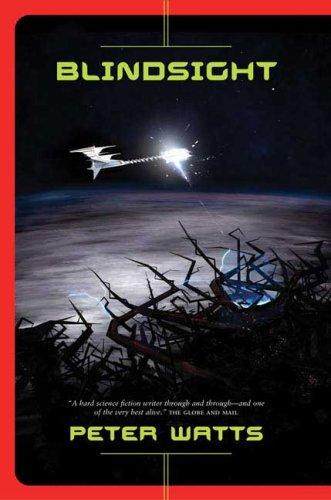
Somebody described this as Sphere mixed with 2001 written by an autistic person, which sounds like an insult and isn’t one, it’s actually the most accurate three-second pitch I’ve read for it. The blurb makes it sound like vampires in space, which made me roll my eyes going in the way it apparently made a lot of other people roll their eyes, and then the actual book turned out to have almost nothing to do with that and everything to do with a question I wasn’t prepared for a novel to ask this directly: what if consciousness isn’t an advantage, what if it’s overhead, a metabolically expensive glitch that a truly efficient intelligence would route around entirely.
The narrator, Siri, is explicitly written as neuro-atypical, and I saw this called out as one of the rare examples of that being handled properly in genre fiction, not shorthand for psychopath-equals-threat, just a genuinely different way of processing the world that turns out to be exactly the skill set this first contact mission needs. Watts leans hard into the science, physics, neurology, evolutionary biology all doing real load-bearing work, and yes, at points it felt like a PhD was the prerequisite for the chapter I was on. I had to slow down more than once.
The aliens are the best part, and I mean that as high praise, genuinely, properly unknowable in a way most first contact stories chicken out of. No handshake moment. No shared universal grammar. Just something on the other side of the glass that might be more intelligent than every human on the ship combined and still, provably, not conscious in any sense we’d recognize, which is where the book’s real argument lives.
It’s a hard read and a short one, which is a strange combination, dense enough that I felt every page. One review paired it with Metzinger’s philosophy of mind work as a companion piece, and that feels right, this is closer to an argument wearing a spaceship than a spaceship story with ideas bolted on. Not comfortable. Very good.