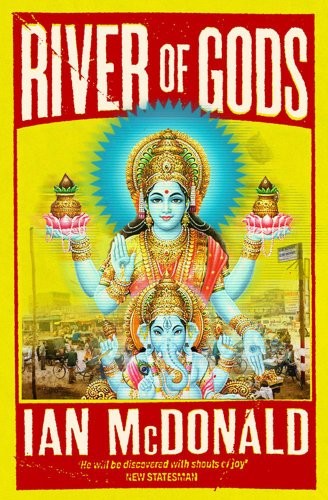
The premise alone earns points, 2047, India split into competing successor states, approaching its own centenary, and McDonald follows something like nine people through it, a Krishna cop hunting illegal AIs, a stand-up comic, a gender-fluid data trafficker, a self-aware soap opera character who thinks she’s real. That last one sounds like a gimmick and instead ends up being one of the most genuinely moving threads in the book, a “soapi” that starts questioning her own existence in a way the human characters mostly don’t have time to.
One review nailed the split-personality of this book better than I could, said the first five hundred pages read like China Mieville and William Gibson’s lovechild, which is a wonderful thing, and then the last hundred feel like someone brought Simon R. Green in to wrap it up. I felt that shift almost exactly where they placed it. The density and ambition that make the first two thirds so good start to work against the book once it needs to actually resolve nine storylines, and the ending arrives faster and thinner than the setup earned.
Nine POV characters is a lot, and I won’t pretend I always knew who I was reading at the top of a new chapter, more than once I flipped back a few pages to reorient myself, which some reviewers found disqualifying and I found more like the cost of admission for a book this ambitious. One reviewer’s line stuck with me more than any actual critique, called the ending “all prelude, no lude,” which is mean and also not entirely wrong, there’s a lot of setup here for payoffs that don’t all land with equal weight.
Still, as a piece of world-building that refuses to default to a European future, this is genuinely rare, and the density of ideas per page, back-alley data brokers, third-generation AIs, an anomaly in the asteroid belt, a marriage falling apart under all of it, is more than most books twice this length manage. Heavy in your hands and heavy going in places, but I’d rather a book overreach than not try.